$ADX Tokenomics & New $ADX Bridge Explained
The $ADX token is a vital part of the heyAura ecosystem. Learn more about tokenomics, total and circulating supply, as well as the new $ADX bridge we're introducing.

1The $ADX token is the heartbeat of the heyAura ecosystem, designed to align users, builders, and protocols through staking, governance, security, and access to product features.
As heyAura is evolving, so does the role of $ADX. We’re making the tokenomics reflect the growing heyAura ecosystem more closely through the introduction of a new staking mechanism, additional token-burning measures, and expanded cross-chain infrastructure.
But how does the $ADX economy actually work? How many tokens are there, where are they distributed, and why does the supply figure on Etherscan look different from the circulating supply? Let's break it down.
What is $ADX?
$ADX is the native ecosystem token of heyAura, originally launched as the utility token of AdEx Network, a decentralized advertising platform. While the project has evolved significantly since the beginning, $ADX remains at the center of the ecosystem. Its role has expanded from its original use cases to support the heyAura AI assistant and its wider network of users, protocols, and partners.
Today, $ADX serves several purposes:
- Governance: Holders of $ADX and $stkADX (the staked $ADX token) can vote on proposals and influence important decisions about heyAura's development.
- Security: Protocols and applications can stake $ADX as a security guarantee when seeking inclusion in heyAura's trusted ecosystem.
- Staking: Holders can stake $ADX to earn rewards and participate in the ecosystem.
- Recommendation boosting: Projects can stake $ADX to increase the visibility of relevant recommendations.
- Premium features: Staking $ADX unlocks access to premium heyAura functionality, including enhanced outputs and higher request limits.
This creates a direct connection between the token and the product, ensuring that $ADX plays an active role in how the ecosystem operates rather than being merely associated with the project.
$ADX supply: How many tokens are there?
Understanding token supply fully means looking beyond the headline figure displayed by a block explorer, though this helps. $ADX has a fully unlocked supply, meaning there are no future scheduled token unlocks from vesting allocations. The maximum supply has already been minted, and the token economy increasingly relies on staking, usage, and burning mechanisms rather than new token emissions. However, as with any token, there is an important distinction between total supply and circulating supply.
Total supply refers to the number of tokens that exist onchain, inlcuding tokens that have been permanently burned.
Circulating supply represents the tokens considered available in the market. Tokens held in certain contracts, locked positions, or otherwise unavailable for trading may be excluded from this calculation.
This is why the number displayed on Etherscan can differ from the circulating supply reported by heyAura or by market data platforms.
Why is Etherscan's supply different from circulating supply?
Etherscan currently reports approximately 203.63 million $ADX on the Ethereum token contract.
However, this figure doesn't provide the complete picture. A significant portion of this supply is associated with historical staking arrangements, burns, and other contract balances. To understand the effective supply, we need to account for these amounts. Here's how the supply reconciliation works:
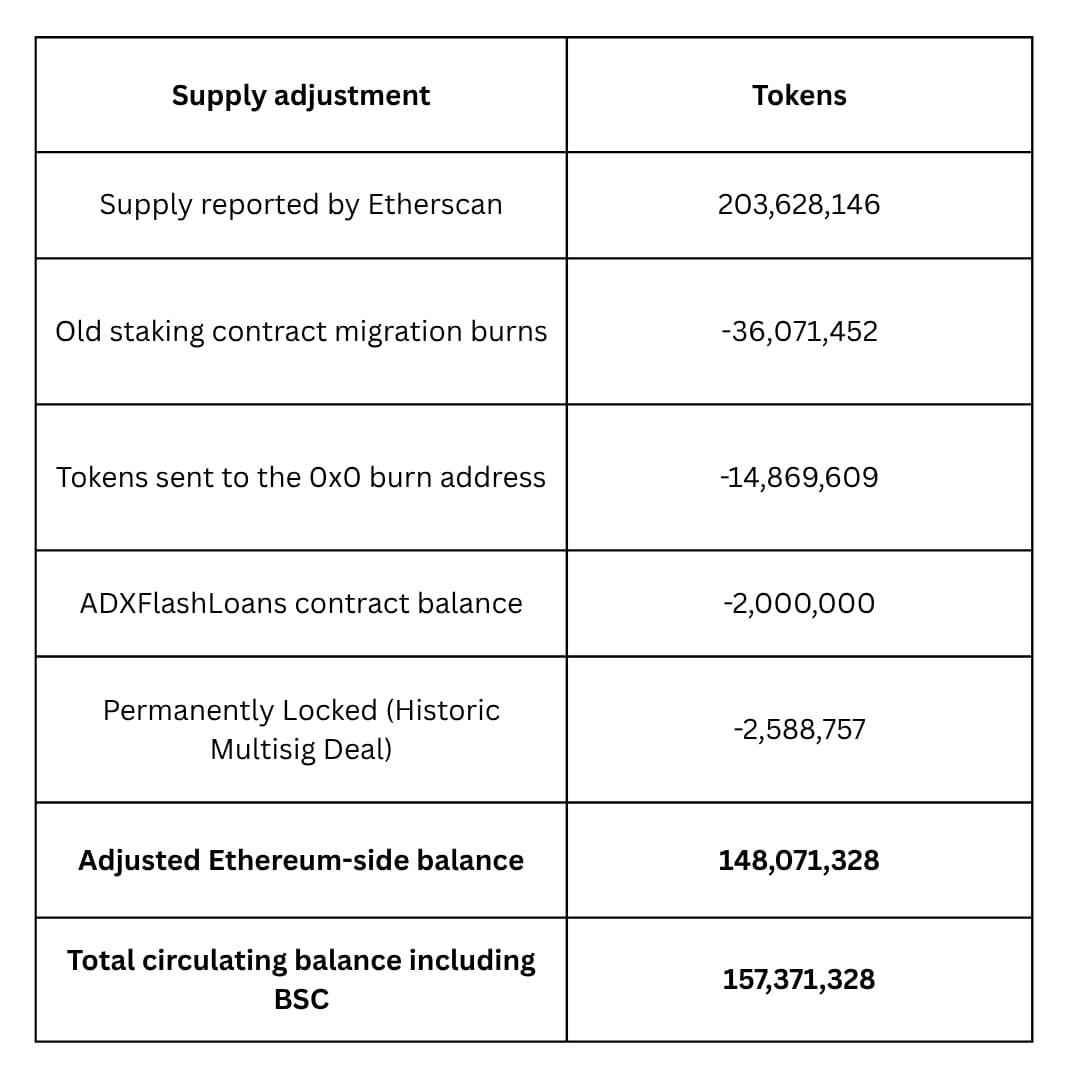
There is another important piece to consider: $ADX also exists on BNB Smart Chain (BSC). Approximately 9.3 million $ADX tokens are held on BSC. These need to be included when calculating the overall supply across the supported networks.
Adding the BSC supply gives us:
- Ethereum adjusted balance: approximately 148.07 million $ADX
- BNB Smart Chain: approximately 9.3 million $ADX
- Combined adjusted supply: approximately 157.37 million $ADX
After accounting for ongoing burns from unmigrated staking positions, the effective circulating supply is approximately 157.3 million $ADX at the time of publishing this article.
Staking and the new $stkADX mechanism
Staking has always been an important part of the $ADX ecosystem. The original staking system, launched in 2019, distributed rewards generated through protocol revenue and additional token emissions. Over time, the staking model needed to evolve alongside the heyAura ecosystem.
The new staking mechanism introduces a unified pool designed to bring protocol revenue and reward distribution together. Instead of maintaining separate staking arrangements, the new model centers around a single staking token: $stkADX.
The migration from the previous $ADX-STAKING positions to $stkADX brings several benefits:
- Unified staking: A single pool consolidates staking and reward distribution.
- Revenue sharing: Stakers can participate in revenue generated by heyAura, including security and discovery deposits, recommendation boosting, and premium product features.
- Governance: $stkADX holders receive full governance rights and can influence the ecosystem's direction ($ADX holders only get half the voting power).
- Product access: Staking unlocks access to heyAura features, creating a direct relationship between participation in the token economy and product use.
The new system also introduces flexible lock-up periods. Users can choose how long to commit their tokens, with longer commitments receiving greater rewards and voting power. The aim is to create a more sustainable relationship between the product's growth and the people who support its ecosystem.
The $ADX burning mechanism
Token burning is another important component of $ADX tokenomics. A burn permanently removes tokens from circulation, reducing the amount of available supply. Unlike staking, where tokens are locked but still exist, burned tokens cannot be recovered or used again. There are several sources of burns within the $ADX ecosystem.
Historical burns
As part of the staking migration and previous tokenomics decisions, significant amounts of $ADX have already been burned. This includes tokens removed from the old staking contract and tokens sent to the Ethereum burn address.
Burns from unmigrated staking positions
The transition to the new staking system included a grace period followed by a penalty period for users who did not migrate their old $ADX-STAKING positions to the new staking contract. After the initial penalty period concluded in October 2026, the community voted to introduce an additional 1% daily burn rate for remaining unmigrated positions.
This creates an ongoing reduction in supply while encouraging holders to move to the new staking mechanism.
Further supply reduction
In addition to these ongoing burns, heyAura plans to burn or lock approximately 7.3 million additional $ADX over the coming months. Together, these measures are intended to reduce the effective available supply and align the token economy with the new staking model.
Just note that burning and locking have different outcomes: burning permanently reduces the total supply, while locking reduces the amount available to the market without destroying the tokens.
New $ADX bridge between Ethereum and BNB Smart Chain
$ADX is currently available on Ethereum and BNB Smart Chain.
In order to improve accessibility and to make the token easier to transfer between supported networks, heyAura is introducing an official bridge powered by Hyperlane to provide a dedicated cross-chain route for $ADX.
It also supports the broader direction of heyAura: building a more connected ecosystem where users can interact with their assets across chains with fewer barriers.
What does the future of $ADX tokenomics look like?
The evolution of $ADX tokenomics reflects a broader shift in the heyAura ecosystem.
The focus is moving towards a token economy where token utility is directly connected to product usage and ecosystem participation, and the different moving parts reinforce each other.
As heyAura grows, $ADX has several roles to play:
- Stakers participate in governance and share in protocol revenue.
- Protocols use $ADX to provide security guarantees and boost relevant recommendations.
- Users stake tokens to access premium heyAura features.
- The burning mechanism gradually reduces the available supply.
- Cross-chain infrastructure makes the token more accessible across supported networks.
$ADX has been part of the journey since the early days of AdEx. With heyAura, its role is expanding into something much bigger: a token designed to power an ecosystem built around making crypto more accessible, intelligent, and useful.
Interested in heyAura? Follow us:
X (Twitter) | Discord | Telegram | Reddit | LinkedIn